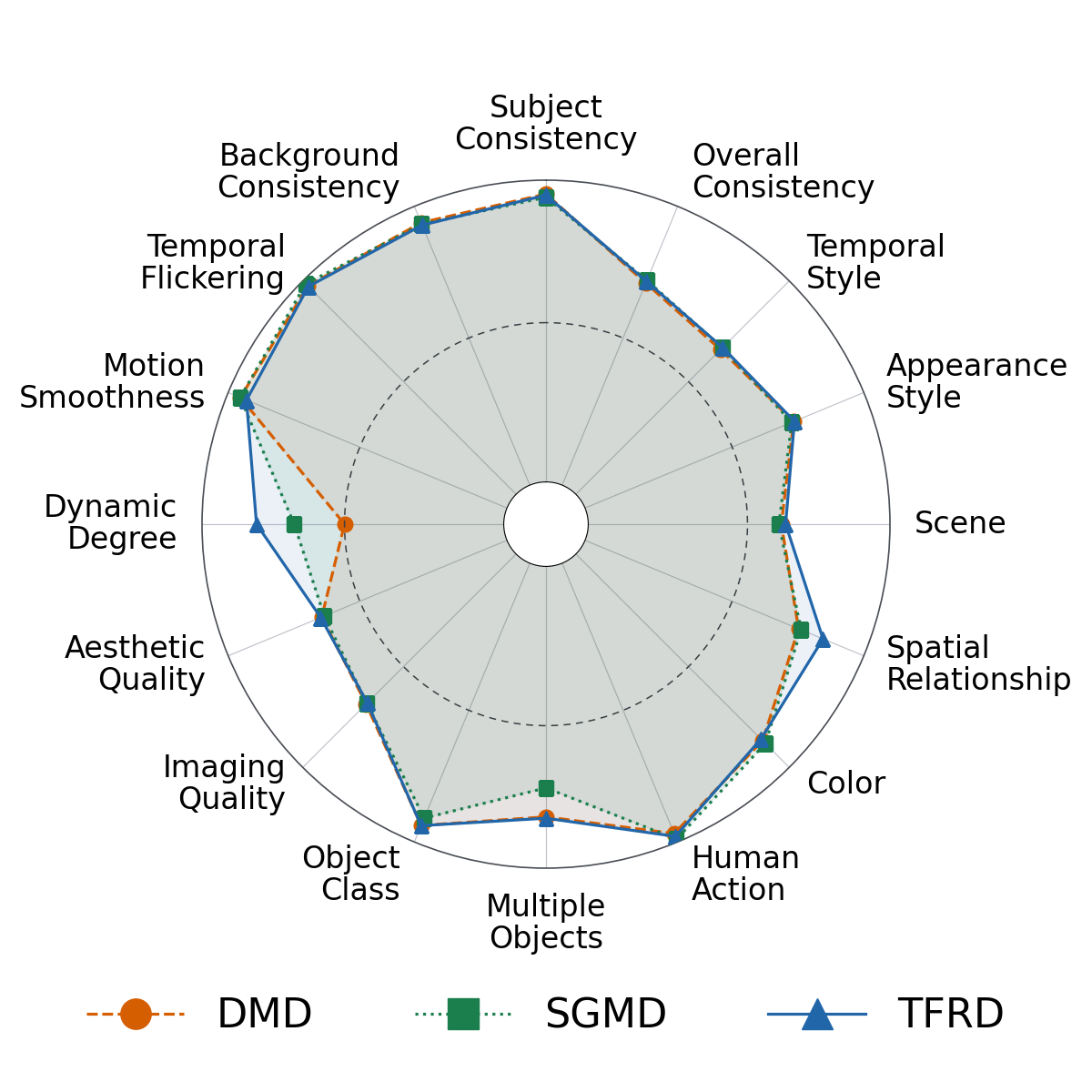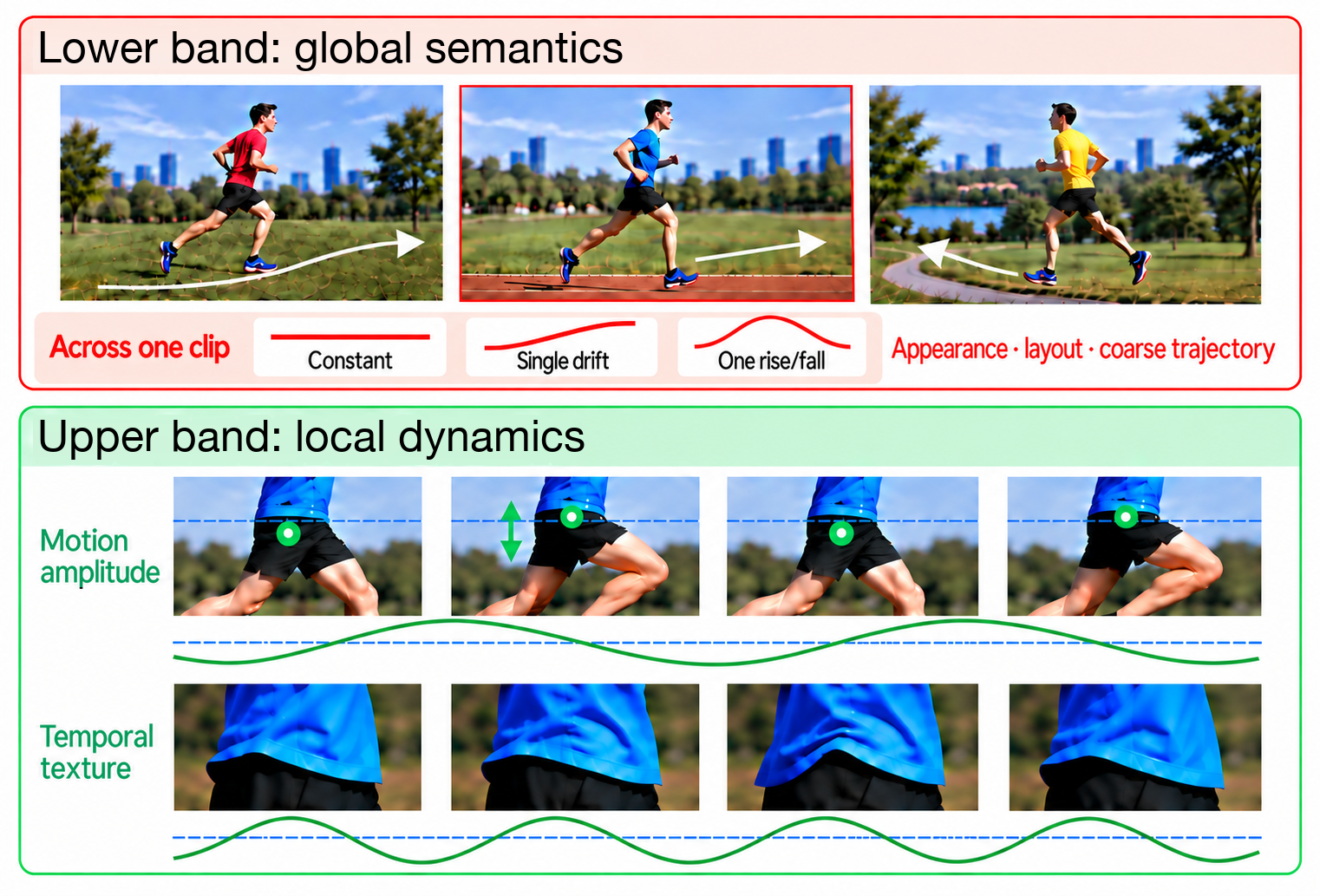
Score distillation is a leading paradigm for compressing a many-step video diffusion or flow teacher into a few-step student. Existing practice is organized around two divergences that expose a semantics–dynamics trade-off: reverse KL divergence anchors semantics but attenuates dynamics, whereas Fisher divergence retains dynamics but shifts semantics. In this work, we show the trade-off is intrinsic to the divergences, for they respond differently to two errors in mode selection and variance retention: Fisher charges the former weakly, and reverse KL the latter. The two errors, however, separate along the temporal-frequency axis: the former is settled in the lower band that carries global semantics, while the latter is recorded in the upper band that carries local dynamics. These findings dictate the design of Temporal-Frequency Routed Distillation (TFRD), which routes the lower band through reverse KL and the upper band through Fisher, and uses a gradient projector to keep the two bands' updates spectrally disjoint. Applied to the 4-step distillation of Wan2.1-T2V-1.3B, TFRD consistently improves the total, quality, semantic, and dynamic scores on VBench over prior methods.